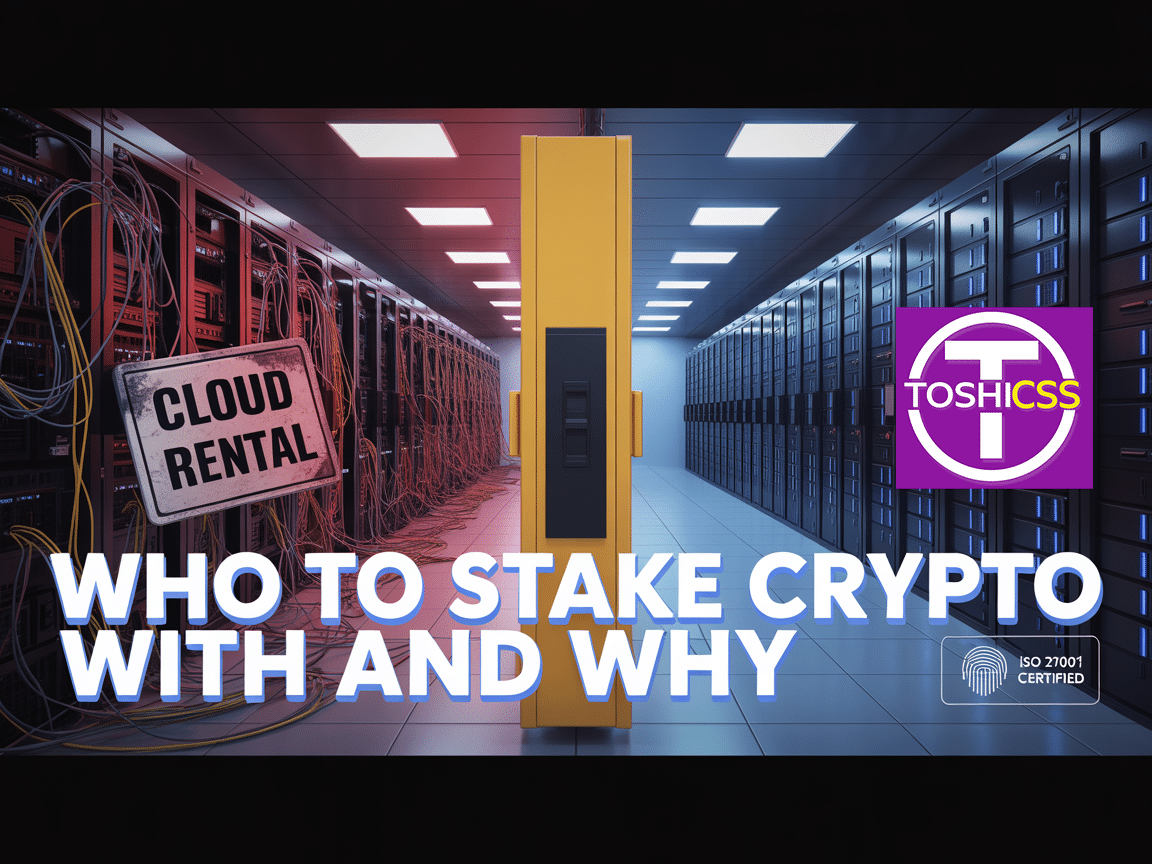
You wouldn’t deposit money into a bank that didn’t own its own vault. Yet, many staking platforms are little more than marketing shells wrapped around rented servers and outsourced operators. For the serious investor, the crucial question is Who To Stake Crypto With and Why, because the “who” matters more than the “what” you stake.
The Hidden Risks of White-Label Staking
Retail staking is often a simple “one-click” solution, but this convenience hides a complex layer of operational risk. Many staking-as-a-service providers use white-label or pooled arrangements where the underlying infrastructure is controlled by anonymous third parties. This creates operational and financial vulnerabilities you must understand:
- Slashing Risks: Staking is based on a Proof-of-Stake (PoS) consensus mechanism where validators are penalized (slashed) for misbehavior, such as “double signing” or extended downtime. If your validator is slashed—even due to a simple operational mistake or misconfiguration by an outsourced operator—you lose a portion of your staked assets.
- Downtime and Missed Yield: A provider that cannot keep its validators online will not deliver the headline staking rate you modeled. Unreliable or insufficient infrastructure causes missed rewards (opportunity cost).
- Lack of Accountability: When a third-party is involved, lines of compliance and operational responsibility are blurred. If a white-label provider fails, you face counterparty risk, potential loss due to company failure, and weak governance.
Due Diligence: How To Stake Crypto With and Why You Must Check the Source
Institutional allocators conduct rigorous operational due diligence (ODD) on staking providers, focusing on verifiable infrastructure and security. To guide your decision on Who To Stake Crypto With and Why, ask these critical questions:
- ?Verify Ownership & Uptime: Does the provider own its hardware and data centers, or does it rely on rented cloud services? Request auditable performance data (30, 90, and 365-day uptime).
- ?Check Security Standards: Does the provider adhere to institutional standards like ISO 27001? Do they have anti-slashing mechanisms and robust security procedures for private keys?
- ?Demand Transparency: Is the leadership team public, visible, and credible? Is the fee structure clear, and are reporting mechanisms in place for easy tax and audit review?
✅ The ToshiCSS Advantage: Transparency is Our Vault
ToshiCSS offers a direct contrast to the risks of anonymous, outsourced staking by providing Proof of Infrastructure and Accountability:
- Fully Owned Data Centers: Our commitment to stable, consistent yield is backed by our fully owned data centers. We control the hardware, the network, and the security protocols from the ground up, minimizing downtime and external operational risk.
- Visible Leadership: Our transparent, public-facing leadership team fosters the trust and accountability that a serious investor demands.
- Institutional Security: Our ISO 27001 Certification validates that our information security and risk management systems meet the non-negotiable standards of traditional finance.
If you are a traditional investor asking Who To Stake Crypto With and Why, ToshiCSS is the intelligent, secure, and transparent path—built for long-term stability.
If you are ready to apply traditional due diligence standards to your crypto portfolio, we invite you to explore ToshiCSS.
If you have questions at all about our infrastructure, security, or getting started, please do not hesitate to call us at (844) 867-4471.